Centralisation and Decentring of “Soviet Film”
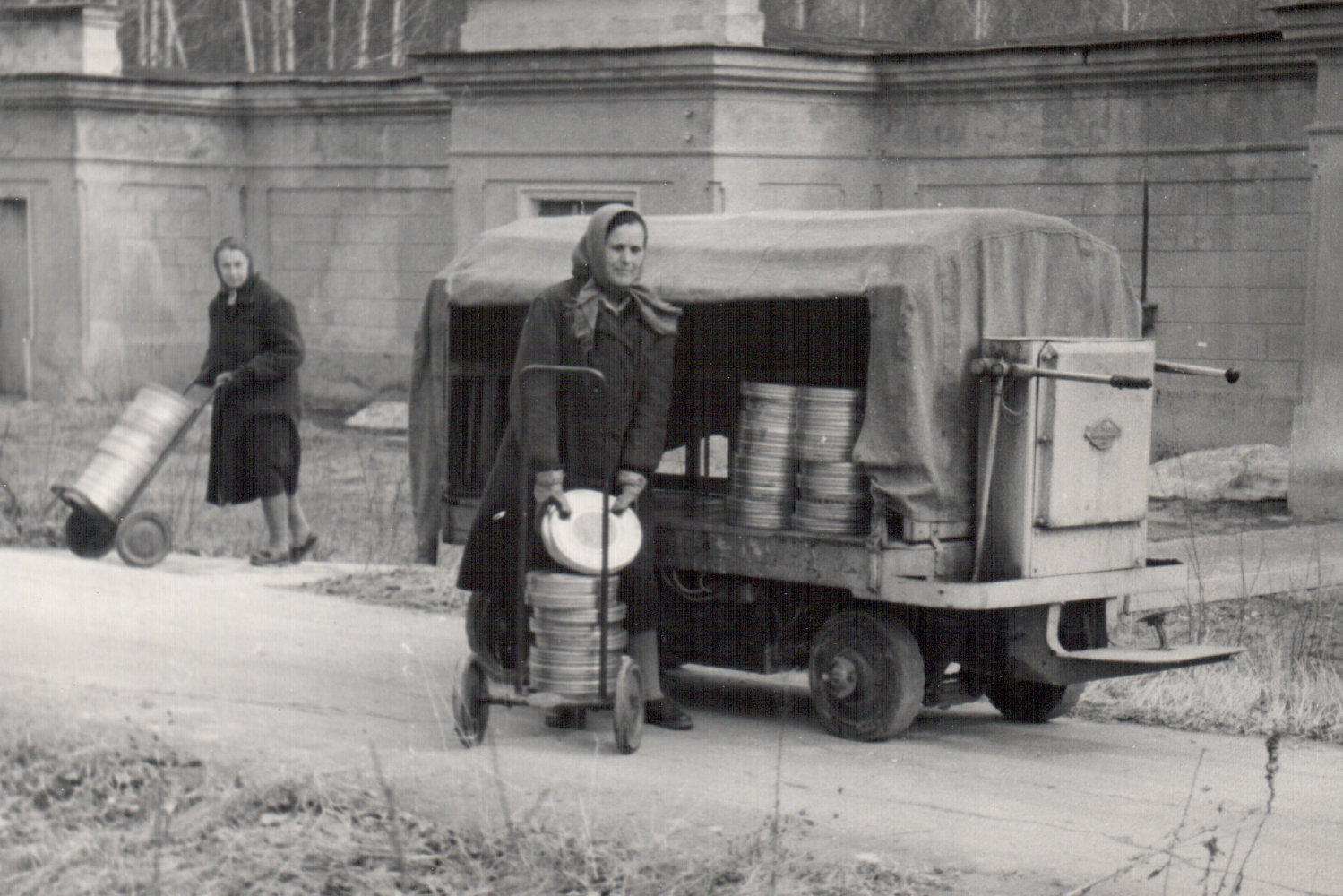
Top: Transporting film reels on the premises of Gosfilmofond during the Soviet period. Exact date unknown. Photograph from the Gosfilmofond Collection.
Middle (left): Today’s view of Gosfilmofond and its surroundings.
Middle (right): A service gate at the Dovzhenko-Centre’s film laboratory.
Bottom: The Dovzhenko-Centre today.
This text reflects on the material infrastructures of the archives of Soviet cinema cultures that shape the legacy of socialist filmmaking as an epistemic object. We focus on three archives – entanglements of infrastructures and discourses that become sites of social linkage, power relations, and collective political experiences – each situated within a distinct geographical and historical configuration, yet invariably conditioned by Russian imperialism. These institutions are the Gosfilmofond in the Moscow region, the Dovzhenko Centre in Kyiv, and the Zharaev Centre for the Audiovisual Heritage of the Peoples of the Sakha Republic. While each case exceeds the scope of the present discussion, we nevertheless seek to illuminate the intricate processes surrounding the cinematic heritage of the socialist era, namely, centralisation and decentring, by placing these three institutions in montage.
Centre-periphery relations assumed a paramount role for the Russian Empire and the USSR. Unlike oversea colonialisms, these continental empires were formed by territorial expansion across a continuous landmass and maintained by asymmetrical power relations, as well as the integration of culturally heterogeneous populations into a centralised political entity. While Imperial Russia had employed the monarchist hierarchies for this purpose, the Soviet axiology mobilised a historically specific articulation of internationalism to sustain its centralised technocracy (Hirsch 2005, Kassymbekova 2016, Martin 2001, Moore 2001). The centralised archival system for Soviet cinema cultures was shaped by these dynamics: materials were extracted across the Soviet republics and managed, restricted, and regulated through the central repository. Although Soviet film justifiably poses a crucial point of reference for much of the leftist film theory and practice beyond the Soviet Union, the coherency of “Soviet film” – the epistemic outcome of infrastructural centralisation – remains systematically unquestioned.
The Gosfilmofond
The Gosfilmofond (“State Film Fund”) is the principal repository of audiovisual documents from the late Russian Empire and Soviet Union. Its institutional predecessor, the All-Union Film Repository, was conceived as a “special safe” for a collection of film negatives selected by Joseph Stalin (Padunov 2006) and was located in Belye Stolby, a rural area 50 kilometres from Moscow. This initiative evolved into the ambitious project of creating a single archival complex for the entire Soviet film production, the progression of which remained slow, as the centralisation of the film industry was still underway during the 1930s, while this process was accompanied with large-scale purges of the film administration bureaucracy (Youngblood 1985, 189–220).
The institution’s function, however, experienced a drastic transformation after the Second World War. The wartime damage to local archives and the seizure of films by the Red Army – primarily in Germany as well as in the newly annexed territories such as Western Ukraine and Western Belarus, the Baltic States (Estonia, Latvia, and Lithuania), and Moldova (Knight 2015) – conditioned the reorganisation and expansion of the repository into a central archival complex. Founded in 1948 as Gosfilmofond, it formed a self-contained archival settlement in which storage vaults, film printing and restoration laboratories, screening facilities, accommodation, dining facilities, administrative infrastructure, a farm supplying agricultural products, as well as later festival spaces, were concentrated in a single, relatively isolated location. The collection expanded through the rapidly developing supply network: film studios across all the USSR’s territory were obliged to transfer copies of the archival holdings and new productions to the central repository (Malyshev 2005, 75–104; Dmitriev 1994, 16–17). While it was connected to the numerous points across the Soviet republics, the Gosfilmofond became the privileged locus of access to the centralised mesh of Soviet film archival regime.
Over the following decades, Gosfilmofond served as both a repository and a research institution, providing filmmakers, scholars, and students from the State Film School in Moscow with access to Soviet and foreign films and related archival materials for viewing, study, and discussion. This included, albeit subject to access restrictions, films that were withheld from general distribution and therefore remained inaccessible to the wider public. In this respect, Gosfilmofond was part of the Soviet Union’s centralised system of film education and research that still influences the study of Soviet film today.
For many international scholars, the experience of Soviet cinema culture was mediated through the archival settlement: a material interface that imparted tangible epistemic consequences. The institution’s proximity to Moscow made it impossible for the visitors to establish direct social connections with filmmaking circles in Kyiv, Almaty, Tbilisi and Yerevan, to name a few major production localities. Discursive operators, such as classificatory systems and catalogues, flattened the heterogeneous institutional and social complexities of the Union’s peripheries, turning them into a homogenised, seemingly coherent study object of “Soviet film.” The term is often used interchangeably with “Russian film” by the same international scholars. By holding the collections of films produced across the Soviet republics, the institution not only preserved them and made them accessible but also framed them within the institutional geography of the imperial centre.
Since the disintegration of the USSR in 1991, the collections of the Gosfilmofond have remained in the repository. Throughout the post-Soviet decades of Russian fossil-fuelled far-right oligarchy, the institution has resisted the repatriation of its holdings (White 2014). Due to the Russian Federation’s de facto looting of large parts of the film heritage from their places of origin, multiple initiatives have emerged to decentre the legacy of Soviet film. What follows is an outline of two of them. The first – developed for the recollection of the film heritage of Ukrainian SSR – exemplifies the attempt at decentring the social reception of archival images. Engaged with the indigenous cinematic practices of the Sakha Republic, the second strategy has unfolded as a methodological recalibration of “Soviet film” as a study object, by accounting for what was previously excluded from its scope.
The Dovzhenko-Centre in Kyiv
In 1994, the Dovzhenko-Centre was founded in Kyiv to reassemble the dispersed documents of Ukrainian film history. Rather than emerging as a purpose-built archive, the institution was established on the grounds of Soviet Ukraine's only film-copying factory. It inherited not only the factory's buildings and technical infrastructure but also the expertise of former employees who had continued to care for film copies after the collapse of the USSR. Their largely grassroots efforts to preserve and catalogue the surviving prints established the Dovzhenko-Centre's first material link to the legacy of Soviet cinema (Honcharuk & Glazunova 2023). Over the following decades, the Dovzhenko-Centre became a site for the preservation, research, and circulation of film materials, ranging from documentations of the Chornobyl disaster to the legacy of VUFKU – the studio which produced films such as Oleksandr Dovzhenko’s Arsenal (1929) and Dziga Vertov’s Man with a Movie Camera (1929).
Following Russia's military invasion of Ukraine in 2014, the Dovzhenko Centre began operating as a public institution, reclaiming film heritage from the aggressor's self-appointed hegemonic role in the continuity with Soviet experience. Gathered from former production facilities, filmmakers' private collections, and surviving distribution prints, the archival images stared back at a society renegotiating its historical imagination in the wake of the Maidan uprising and the outbreak of war. In this configuration, the recovery of region’s socialist filmmaking enabled (audio)visual memory to forge new, turbulent connections with the complex collective political experiences of the present. [1]
The Zharaev Centre for the Audiovisual Heritage of the Peoples of the Sakha Republic
While the Dovzhenko-Centre reassembled dispersed archival materials in light of current political experiences, the Zharaev Centre for the Audiovisual Heritage of the Peoples of the Sakha Republic (in the largely Arctic region of northeastern Siberia) preserves traces of cinematic practices that largely emerged outside of production institutions. Colonised by Russia in the 17th century, the Sakha Republic lacked a national film studio during the Soviet era. State socialist ideology placed the USSR’s culturally heterogeneous constituents on a linear developmental spectre from primitive communism to centralised Party-led socialism, casting Indigenous communities of the Far North and Far East as “backward” and in need of Moscow’s enlightenment (Hirsch 2005). This framework established a hierarchical division of labour when filming the region, with predominantly male and Russian expeditionary filmmakers in leading roles (directors, scriptwriters, administrative staff), while women and Indigenous people performed the remaining tasks (Damiens 2024).
Under these conditions, as Caroline Damiens notes, the archive’s focus shifts from film production to the distribution of cinema. It documents the expansion of cinema through mobile projection crews, local projectionists, and cine-yurts – traditional collective dwellings that have been repurposed as screening venues – revealing the technological and social networks through which socialist screen culture circulated across the republic. Drawing on the Centre’s collections and the work of local historians and archivists, Damiens argues for “provincialising” Moscow-centred film history and its conceptual axes, such as authorship and style. Instead, she calls to account for the “cinema cultures” – complex assemblages of images, technologies, human collectives, and natural environments (Damiens 2024). This subject specification renders impossible to subsume the multiple crystallisations of social praxis into a homogeneous historiographic narrative of “Soviet film.”
* * *
Yet these projects of archival decentring depend upon material infrastructures that are inseparable from their political surroundings. Since Russia's full-scale invasion of Ukraine in 2022, the Zharaev Centre has remained inaccessible to international scholars. While this text was in progress, a Russian missile strike on Kyiv on 15 June 2026, which resulted in multiple civilian casualties and turned the local film studio's collection of nearly 100,000 film costumes, including items associated with the work of Sergei Parajanov, to ash. The assembly of such a collection takes decades. Its destruction unfolded within a couple of hours. The process of decentring and the persistence of centralisation remain dialectically bound in this temporal incommensurability of preservation and destruction.