Heddy Honigmann, Ex-Yugoslav Auteur?
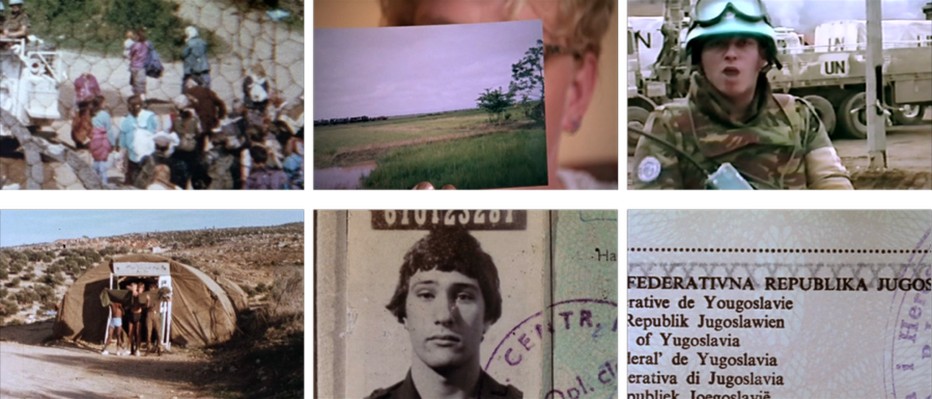
Stills from Crazy (Heddy Honigmann, 1999).
The study of moving images in the area formerly known as Yugoslavia is, today, alive and well. Yet there remains a nagging issue in contemporary writing on film from the region. What should we call it? Yugoslav and post-Yugoslav cinema, Balkan cinema, Eastern, Southeastern, Central European cinema; these are just some of the geo-epistemic labels commonly in use. Each has its own meaning and explanatory value (as well as political power), but together they do not make up a coherent whole. This confusion is by no means unique to cinema, yet it is especially acute here by virtue of the medium’s collaborative and border-crossing mode of production. This issue also isn’t exclusive to the Yugoslav corner of the world, yet it is in newly independent or post-transitional states – each eager to assert its narrative of history and future – where cultural taxonomy is most intensely contested. (For an illuminating consideration of this issue from the perspective of pre- and post-handover Hong Kong, see Sia 2024.) Moreover, the fact that classification is a field of struggle and that we have arrived at no consensus as to where Yugoslav film begins and ends is not really a problem at all. It is, as a matter of fact, an auspicious starting point for a renewed, internationalist conception of a Yugoslavism that abandons the policing of ethnic borders.
This is precisely why my aim is to add another category to the jumble: ex-Yugoslav cinema, by which I do not simply mean films from what used to be a common country, or at least not quite. I am referring to films made in the Yugoslav territories in the period of their disintegration – that is, roughly, the 1990s – by ‘outsiders’: cineastes who themselves did not hail from the region. During and immediately after the Yugoslav wars, numerous international (but especially Western European) reporters, writers, musicians, filmmakers, and intellectuals, from Bernard-Henri Lévy and Susan Sontag to Bono, spent time in the republics, especially Bosnia and Herzegovina. While in the region or upon their return home, many of these visiting directors made films, mostly documentary, more and less experimental.
The ex- in my use of ex-Yugoslav cinema is not – or at least not exclusively – a temporal index, but instead names a distance, separation or gap between the country of production and the place of origin of its maker. A provisional canon of ex-Yugoslav cinema includes Jean-Luc Godard’s I Salute You, Sarajevo (Je vous salue, Sarajevo, 1993) and Our Music (Notre musique, 2004), Philippe Grandrieux’s Return to Sarajevo (Retour à Sarajevo, 1996), Johan van der Keuken’s Sarajevo Film Festival (1993), Angela Ricci Lucchi and Yervant Gianikian’s Nocturne (1997), Marcel Ophüls’s The Troubles We’ve Seen (Veillées d'armes, 1994), Paweł Pawlikowski’s Serbian Epics (1992), and Hito Steyerl’s Journal No. 1: An Artist’s Impression (2007), among others. These films are aesthetically and politically heterogeneous, yet they share two things: 1) they all deal in some way with Yugoslavia and its destruction, even if they were made in the 21st century; and 2) the filmmakers came in on a temporary basis, leaving after their project was finished.
In this text, I analyze one film in particular – Heddy Honigmann’s Crazy (1999) – explicating it as a paradigmatic example of ex-Yugoslav cinema through the lens of Jacques Lacan’s concept of extimacy: the emergence, in the words of Samo Tomšič (2025, 32), of an “element of foreignness at the intimate core of the subject … a heterogeneous exteriority within the subject, an exteriority that is nevertheless constitutive for the subject.” Honigmann’s entire oeuvre could be described as extimate, dislocated between in and out – not so much transnational as paranational, or even ex-national. Born in Peru in 1951 to Jewish refugees from Poland and Vienna, Honigmann studied in Lima and Italy before moving to Amsterdam in the 1970s. In between, she made documentary and fiction films in the Netherlands, Peru, Brazil, Paris, Germany, Argentina, South Africa, Russia, Cuba, and New York. Today, she is mostly known – or all-too-often unknown – as a Dutch filmmaker, even though the label does not do her cosmopolitan work any justice. (For a rare and insightful academic study of Honigmann’s cinema, see Elsaesser 2019.) In 1999, Honigmann released Crazy, one of two films (alongside Good Husband, Dear Son) she made about the Yugoslav wars, especially in Bosnia, and the aftereffects of war both on people in the region and elsewhere. Crazy consists of conversations with Dutch UN peacekeepers stationed in late-20th-century combat zones around the world: Rwanda, Cambodia, Lebanon, and most prominently Yugoslavia – specifically Busovača, Bihać, and Srebrenica – ending with a scene at a military recruitment center where young Dutch soldiers are being sent to Kosovo.
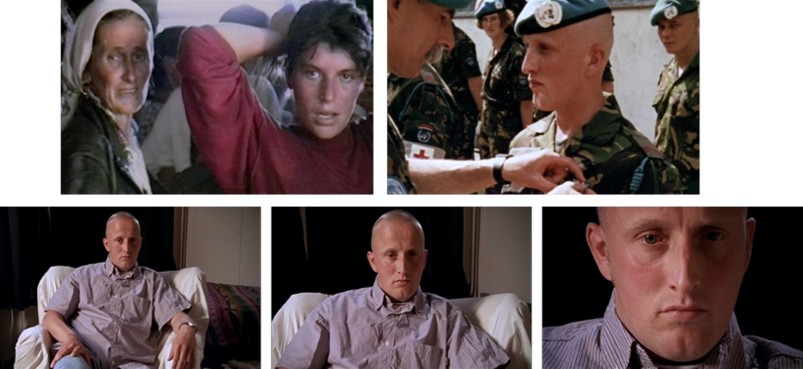
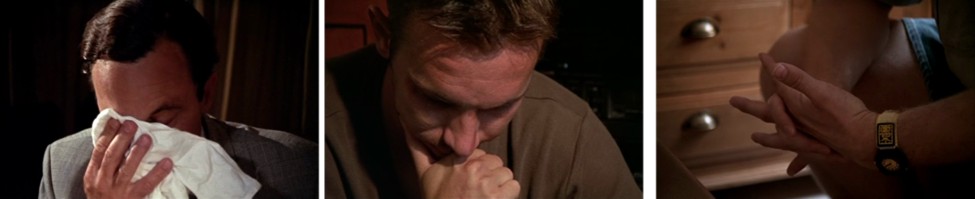
The film is a study of war-induced trauma, PTSD, and the subjectivity and responsibility of international troops in areas of crisis where crimes against humanity are committed. Yet I find Crazy especially intriguing for two formal reasons: first, it belongs to an important subset of ex-Yugoslav films made entirely abroad, relying on found and archival material, in this case photographs, 8mm home movies, video and TV recordings, as well as texts (documents, letters, postcards), sourced both from personal collections and institutions. Memory – especially intimate, traumatic – is rendered through technical supports, innermost thoughts externalized though media representation. Second, music in the film occupies a privileged, cathected position. Each of the interviews ends with a song, during which Honigmann’s camera remains focused on the subject, looking at their face or hand gestures or other somatic reactions. These songs, ranging from Pavarotti and Pergolesi to Guns N’ Roses and Europop, are important to the interlocutors in different ways, symbolically, emotionally, serving as triggers of involuntary memory. The director, for instance, looks at a UNPROFOR commander sweating and twitching over Seal’s 1991 hit “Crazy”, as it brings up associations with the siege of Sarajevo. Honigmann also films an officer talking about his wedding in Sarajevo over Bosnian pop singer Dino Merlin’s song “Prokletog me bog stvorio” (“God Created Me Cursed”), and she finally looks at a man deployed to Srebrenica in summer 1995.
Over the sounds of U2’s “Sunday Bloody Sunday” (1983), Honigmann cuts between a still of two women in the Dutch base in Srebrenica in July 1995, a photograph of the Dutch soldier in question (private first class Paul Boomsma) receiving a military medal, and finally Boomsma sitting in a lounge chair, facing the camera while U2 plays on the soundtrack. Honigmann records Boomsma in an uninterrupted four-minute take – running for almost the entire song – as the camera gradually inches closer, observing his facial expression and ending in a tight close-up of the officer’s face.
The film never explicates what exactly this song means to this person, except that he heard it on the radio during his mission in Bosnia. What is more, for all its use of already-existing material, Crazy never shows us devices of visual or sonic (re)production, such as cameras, tape or CD players, etc. The images and sounds coming out of these technologies are visible and audible, but the machines themselves are not. Where is “Sunday Bloody Sunday” in this sequence even coming from? Is it playing in the room with the officer? Or is the music non-diegetic and virtual, audible only to the spectator outside the scene, ‘imposed’ in editing by the filmmaker? I argue that the answer is both these options and neither at the same time. This is exactly where the film is at its most politically radical and extimate – which is to say ex-Yugoslav.
Let us remind ourselves of Lacan’s discussion of the prefix ‘ex’ as marking a register that precedes the distinction between the intimate (subjective) and the public (intersubjective). By complicating and ultimately refusing any distinction between internal and external, diegetic and non-diegetic (in this song but also throughout the film’s deployment of songs), Crazy introduces an ontological indiscernibility, instability – or what Lacan called an ‘ambiguous mediator’ – into discourses striving to normalize and objectify clean-cut boundaries between inside and outside, agent and observer, or victim and perpetrator. One of these ideological discourses is, of course, that of UN peacekeepers, which one gets an earful of in the film: we were powerless, we didn’t know, or even if we knew we could do nothing. Through its use of music, Crazy disrupts absolute divisions between inner and outer, actor and bystander, participant and spectator, instead demonstrating not only how war (in the form of music) is still inside people who consider themselves as outside, but by the same token also how they are still inside the war, which is to say how they – and by extension we as the film’s viewers – are implicated as something other than innocent.
It is this operation, which Freud called ‘unbordering’ (Entgrenzung, also referred to as ‘boundary dissolution,’ see Freud 1930), that I want to conclude is central to Crazy, and, perhaps, to ex-Yugoslav film as such. Rejecting clean distinctions between interior and exterior (or rather exposing the overlap between them), Crazy articulates a topological continuum between in and out, insider and outsider, doer and viewer, as seen in Honigmann’s employment of testimony, witnessing, and implication. There are thus two more features to add to our definition of ex-Yugoslav cinema: 1) it is a cinema centrally concerned with the status and power of media, especially modern image media, as an emissary between self and other, domestic and foreign, us and them; and 2) it approaches Yugoslavia not as a historical carcass to be extracted, but as something unrealized, liminal, and porous, in a perpetual process of becoming: an entity that continues to haunt, traverse boundaries, and that still traverses us whether we like it or not.